
First of all, a case report incriminates hydroxychloroquine, a synthetic derivative of quinine used for rheumatoid arthritis and systemic lupus erythematosus, as a possible cause of thrombotic thrombocytopenia purpura (TTP) (82). Disease progression was detrimental and patient died in spite of drug withdrawal and plasma exchange. Moreover, for the first time an antiretroviral treatment of human immunodeficiency virus consisting of tenofovir/emtricitabine was found to have a causality relationship with immune TTP (83). After the cessation of the drug and the initiation of corticosteroids and azathioprine the patient recovered. Last but not least, several antibiotics such as ciprofloxacin, penicillin, and metronidazole were reported with probable evidence to cause DITMA (2).
Cases reporting a link between the aforementioned TKIs and drug-induced TMA have been described in literature (6, 53–56). Thrombotic microangiopathy (TMA) is a pathological syndrome characterized by microangiopathic hemolytic anemia (MAHA), thrombocytopenia, and organ damage, with predominant involvement of the kidneys and/or the brain (Fakhouri et al., 2017). AIHA, autoimmune hemolytic anemia; DIC, disseminated intravascular coagulation; Hb, hemoglobin; HPF, high-power field; LDH, lactate dehydrogenase; Plt, platelet; PRCA, pure red cell aplasia; rUPCR, random urine protein creatine ratio; ULN, upper limit of normal; yr, year. In many cases the blood vessel damage in the kidneys and brain will reverse with time. In the normal kidney (as in the rest of the body), there are small blood vessels called capillaries.
Visual Effects
Shiga toxin was first detected in Shigella dysenteriae and this remains an important cause of HUS in developing countries. The clinical features are similar to STEC‐HUS but the diarrhoea is initially more watery before becoming bloody or mucoid and fever is common. Although less than 10% of children with the infection will develop a TMA, it has a high mortality rate and those who survive are more likely to develop chronic kidney disease.

HSCT-induced TMA (HSCT-TMA) has a wide range of reported incidence (up to 80%), that may be explained by the retrospective nature of the studies, the simultaneous analysis of pediatric and adult populations and a lack of uniform diagnostic criteria. These are highly complex patients because of the procedure itself and its adverse effects, such as bone marrow ablation, toxic drug effects and immunological reactions against an allogenic graft. Consequently, a high level of suspicion is essential to make an early diagnosis 8,88, 89, 90, 91, 92. Drug withdrawal and supportive care are the only therapeutic approaches available. The response to plasmapheresis is poor, and red blood cells (RBC) transfusions could exacerbate TMA 21,23. Some reports suggest improvement in survival and kidney function with rituximab 24,27 and eculizumab 28,29.
Clinical Panel Debate: CAR T-Cell Therapy Vs Bispecific Antibodies
- Immediately after HSCT there is a high risk of AKI, with risk factors attributable to the procedure and the drugs administrated.
- Although the mechanisms of endothelial injury during DITMA still remain unknown; immune-mediated mechanisms or dose-dependent and cumulative toxicity are implied (11).
- Complement‐mediated aHUS can be caused by genetic mutations and autoantibodies.
- CR, complete response; HCT, hematopoietic cell transplantation; hrTMA, high-risk TMA; OS, overall survival; rUPCR, random urine protein to creatinine ratio.
- Abdominal examination revealed minimal bowel sounds with a soft and diffusely tender abdomen.
While eculizumab has emerged as one of the most promising treatments for other TMAs, such as aHUS, its efficacy in HSCT-TMA is arguably modest. Retrospective studies that showed superior results when compared to plasmapheresis were based on small samples 100, 101, 102, 103, 104. Worse outcomes were described in patients with higher sC5b-9, with a lower likelihood to respond to treatment 103. More recently, Jodele et al. 103 showed a 50% rate of complete response to eculizumab, with severe disease being less responsive, which could suggest the existence of other targets of endothelial injury pathways.
Drug-induced Thrombotic Microangiopathy: Incidence, Prevention And Management
Moreover, according to consensus opinion (Palma et al., 2021), regardless of whether a toxic or immune-mediated form, a trial of TPE is recommended in all patients with a suspected diagnosis of severe DITMA, in addition to suspected-causative drug suspension. During TPE, platelet count, haemolysis lab tests and renal function should be carefully monitored. In summary, other studies are needed to confirm a potential role of TFE and RTX in DITMA.

In a large study by Cavero et.al (Figure 5), 20% of the patients with malignant hypertension had TMA, and 60% of those were due to aHUS. Over 70% ultimately required dialysis, much worse than those without TMA. Typically, proper management of DITMA mainly involves withdrawal of the suspected causative drug and supportive care. Resolution or improvement of TMA is observed after the drug is stopped or dose reduced; however, discontinuation alone is often not enough to lead to clinical recovery and some degree of kidney injury can persist. In these patients, especially in case of advanced kidney disease, other therapies need to be considered.
Charting The Course: The Pharmacist’s Role In Safeguarding Patients From Immune-Related Adverse Events
This resulted in ravulizumab having an increased half‐life of ~52 days compared to ~11 days with eculizumab and therefore, up to an 8‐week dosing interval with ravulizumab versus 2 weekly with eculizumab. Just like in any secondary TMA, treatment of the underlying disease is mandatory 141,147. Clearly, further studies are required to determine the mechanisms of TMA, given both the rarity of this situation and the common presence of confounding factors. Most works about haemolytic anemia in the context of hematologic tumor report all kinds of causes, with only a few studies focusing on TMA. Besides, the majority includes both solid and hematologic tumours, with a broad incidence rate for the latter – 8% to 50% of TiTMA 34,139,141,142.
- TMA resulting from quinine may involve immune injury to endothelial cells.10 Better understanding of the mechanisms of DITMA should provide a basis for better diagnosis and treatment.
- His platelet counts recovered completely by hospital day 2, although he continued to have worsening leukocytosis, anemia, and dialysis-dependent anuric renal failure (initially continuous veno-venous hemodiafiltration due to hypotension).
- Other complement regulators increase the decay of convertases, the enzyme complexes necessary to drive complement activity.
- The endomyocardial biopsy revealed mild cardiomyocyte hypertrophy but otherwise no evidence of myocarditis or infiltration.
Managing Iron Replacement Therapies For Patients With Inflammatory Bowel Disease
Carboplatin has very few cases reported, mostly in coadministration with drugs like gemcitabine, docetaxel or trastuzubam 51, 52, 53. The pathogenesis of MMC-induced TMA involves direct endothelial toxicity 18,20, although immune-mediated reactions have also been described 21,22. Evidence-based medical guidance in the management of cancer-related TMA is scarce and the previous knowledge about primary TMA is valuable to understand the disease mechanisms and the potential treatments. Thrombotic microangiopathy is a syndrome triggered by a wide spectrum of situations, some of which are specific to the Oncology setting. It is characterized by a Coombs-negative microangiopathic haemolytic anemia, thrombocytopenia and organ injury, with characteristic pathological features, resulting from platelet microvascular occlusion.
Innovations In Lymphoma Treatment And The Growing Impact Of Bispecific Antibodies

This typically occurs later in the pregnancy; helpful diagnostic tests are abnormal uterine doppler and elevated sFlt-1/PlGF ratios (the latter are not yet available in the United States). Failure of TMA to resolve upon delivery is suggestive of other etiologies. The mutations reported as “pathogenic” or “likely pathogenic” are known to cause dysregulation of complement activation. However, less than 50% of the genetically identified variants have a known functional consequence. Computational prediction algorithms are used to predict the potential impact of these “variants of uncertain clinical significance” (VUS) on the mature protein. The presence of such variants is particularly vexing for clinical management.
Precision Matters: Foundations Of Biomarker-Driven Care In Non-Small Cell Lung Cancer
Both Immune-mediated and Toxicity-mediated mechanisms are included in this table. The scores represent out assessment of the strength of the causal association of the drug with TMA. (1-Definite Causal Association; 2-Probably Causal Association; 3-Possible Causal Association; 4-Unlikely Causual Association). The first reported case of monoclonal antibody-induced TMA described a patient treated with anti-T cell monoclonal antibody muromonab-CD3 (OKT3) (65).
Advancements In Extensive-Stage Small Cell Lung Cancer Therapy: Integrating Clinical Evidence To Fill Gaps In Care
For 14 of the 31 drugs, there was only one report with definite evidence. Forty-nine articles presented group data with TMA attributed to 14 drugs; none of these reports had evidence supporting a definite causal association. We performed a literature review in order to understand the extent of the complement activation searching both for decreased serum value of complement proteins and complement deposition in kidney biopsy. More than half of the patients with DITMA who underwent a renal biopsy showed the presence of complement factors at IF staining (38/66; 59%) (Table 2), mainly identified in the capillary wall (24/27; 88%). Once the presence of TMA is identified, the focus becomes finding the underlying etiology.
An autopsy-based study showed that patients with acute GVHD had a higher probability of developing TMA, independently of CNI and mTORI use 97. On the other hand, a series of 4 cases of biopsy-proven HSCT-TMA described a simultaneously acute and/or chronic GVHD in other organs 113. GVHD is an epithelial cell disease mostly affecting the gastrointestinal tract, skin and liver, that has been identified as a major risk factor for HSCT-TMA 8,94, 95, 96, 97. Kidney disease could be a complication of monoclonal gammopathy, including cast nephropathy, glomerular diseases and electrolyte disorders. It is essential to distinguish proteasome inhibitors (PIs) kidney toxicity from complications of gammopathies 78.
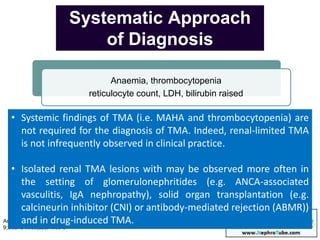
Finally, when there is ambiguity in clinical presentation, biopsy of the affected organ (most commonly kidney) should be considered. Characteristic findings of acute TMA on kidney biopsy, such as glomerular thrombi, capillary fibrinogen deposition, and endothelial swelling, can lead to early diagnosis and appropriate initiation of treatment. Alternatively, the lack of TMA on the biopsy can help establish alternative diagnosis and prevent unnecessary treatment.