
In 2018, the journalist Bari Weiss crowned a heterodox group of writers and cultural figures as the “Intellectual Dark Web.” The IDW, the story goes, promised to deliver a substantive critique of left-wing orthodoxy that had not emerged from the traditional Right. These new figures were also using new media, especially podcast platforms, to reach younger audiences and generate buzz for their intellectual movement. The intellectual dark web, which can be seen as a broad populist movement spanning the left and right, has been going on about identity politics and its postmodern roots for more than a decade. Now, its ideas and figures have helped elect a president, and some of them – Musk, Gabbard and Kennedy Jr – have roles in Trump’s administration.
The Reason Memes Aren’t Good Anymore

The IDW defined itself against the ascendant culture of ‘no debate’, and Rogan hosted those forbidden debates. In time, these boundaries may solidify as some thinkers renounce the movement and others join it, as some ideas are rejected and others sanctioned. If that happens, we may be able to revisit this question for a clearer answer. If not, then the Intellectual Dark Web will likely be relegated to the cultural closet alongside other trendy, but ultimately fruitless, fads. Today, the radio waves have simply been replaced by YouTube, podcasts, and social media, platforms that can reach much larger audiences than the AM signals of yesteryear. In fact, as Pullmann points out, Rogan, Peterson, Shapiro, and Rubin have a combined reach that competes with Fox News and legacy media such as the Times and the Washington Post.
Intellectual Dark Web
If conservatism is to survive, let alone flourish, then we have a simple choice to make. We must embrace the principles that gave rise to the intellectual dark web and dump, once and for all, the principle-free world of the unintellectual dark web that values nothing but clicks and cash. This thirst explains how Carlson dismissed those caring about Oct. 7 as being obsessed with “foreign” matters before traveling to what seems like every country in the world to extol their virtues, fictional or otherwise. This thirst explains how Johnson, a Christian husband and father, embraced and emulated Andrew Tate, a Muslim pimp and self-professed abuser of women, before defending himself by misappropriating a Bible verse. This thirst explains how Candace Owens went from being an immovable supporter of Israel to one of its most enthusiastic (and spectacularly ignorant) critics seemingly overnight, regurgitating the same antisemitic Wikipedia articles that were available while she was flying to Israel to celebrate the opening of the U.S. Bari Weiss profiles the “Intellectual Dark Web,” (I.D.W.) a group of loosely-connected thinkers that are getting more attention than ever before in our fraught era of discourse.
A Case Study Of Jordan Peterson And Ben Shapiro
- They also have resentments to be capitalized on, and a commitment to rationality that can all too easily be transformed into a commitment to rationalizing their less salubrious political desires.
- But writers who suggest that black people are relatively more likely to be stupid are likely to have a much rougher time of it than in the 1990s or the aughts.
- Nonetheless, as Brooks argues, the so-called IDW still represents something more than just garden-variety cultural conservatism even if the two share plenty of terrain.
- Finally, although Perspective’s implementation is not open-source, their team has released information on how the current system was trained and deployed, including the pretraining of the model (Lees et al. 2022).
- According to this way of thinking, the less power you have, the greater your worth, and vice versa.
- Weinstein says our institutions need people who can stand up to the pressures of conformity and authority.
Most simply, it is a collection of iconoclastic thinkers, academic renegades and media personalities who are having a rolling conversation — on podcasts, YouTube and Twitter, and in sold-out auditoriums — that sound unlike anything else happening, at least publicly, in the culture right now. Feeling largely locked out of legacy outlets, they are rapidly building their own mass media channels. Douglas Murray has been fighting with Joe Rogan and comedian Dave Smith over Palestine and Second World War revisionism.
Why Is The Intellectual Dark Web At War With Itself?
Following Liu’s own invented state of Basuria or Bāshǔlìyàguó 巴蜀利亚国, his followers have begun inventing their own. Liu Zhongjing believes that the Chinese, beginning from the administration of the Qin Dynasty, had become a fellaheen nation. A fellaheen empire has only population, not people with an ethnic identity. Therefore, there is no Han ethnic group because the supposedly Han people are fellaheen. Fellaheen is not an ethnic identity, so they are simply slaves laboring under imperial bureaucracy. Also, he supports the idea of “various Chinese nations,” so in Sichuan, there’s a Basuria, in Hubei a Jingchuria, in Guangdong a Cantonia… It’s ridiculous, isn’t it?

Underlying each is a simplistic story of a natural order corrupted, of objective truth obscured by a relativistically minded culture too afraid to face it. If the IDW is attractive to some, the compelling simplicity of its message — that, beneath all the chaos of modern life, there is an immutable order worth defending — is a major reason. In 1982’s Orality and Literacy, Ong theorised that literacy is so profoundly mind-altering that it “restructures consciousness”.
The Western Pursuit Of Truth
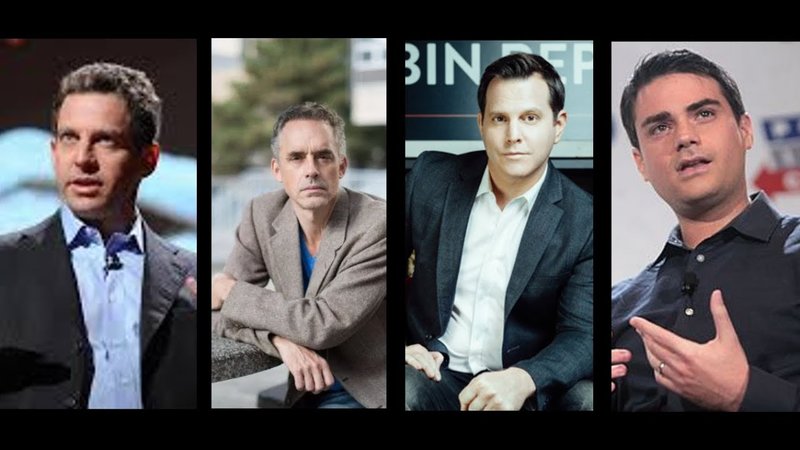
The term is used to describe a group of public figures with varying political beliefs who support freedom of speech and often voice criticisms of political correctness, third-wave feminism and identity politics. The term “intellectual dark web” was coined, almost tongue-in-cheek, in early 2018 by Eric Weinstein, a mathematician, manager at Thiel Capital, and op-ed writer, and was meant to recognize a network of “renegades” in academia and media who reject identity politics in the name of unhindered dialectic (“free speech”). The group includes the likes of Islamophobic blogger and neuroscientist Sam Harris, former Breitbart editor Ben Shapiro, failed libertarian comedian Dave Rubin, and Jungian clean-your-room guy Jordan Peterson. If the intellectual dark web were to acknowledge its place within the conservative tradition — or perhaps if the public were to acknowledge it for them — this might have some beneficial effects for American political discourse. Namely, it would allow us to ask them some important questions about what they actually believe is wrong with the United States.
Members Of The Intellectual Dark Web Want To Be At The Center Of Intellectual Debate But The Center Has Shifted
Andrew Sullivan published an entire issue of the New Republic devoted to presenting, and debating, Charles Murray’s claim that black people were, on average, less intelligent than white people. Just below the surface of the roiling debates about how and why our country got into its current predicament, a radical movement is afoot. Sometimes called “the intellectual dark web,” it lives largely on the internet, but it isn’t a site or a channel, it’s a collection of thinkers (and it’s not the dark web of anonymous cybercrooks you’ve probably heard of). I actually see it not so much as a web but a nest containing rare birds that turn out to be more common than you might think.
Access This Article
While libertarianism is a conservative cousin of neoliberalism, because it claims to adhere to principles advocated by 19th century liberal figures like John Stuart Mill, it can be less authoritarian than Trump’s apocalyptic fascism, even as it also has been an important source of his racist rhetoric. After the Tea Party’s extremism had become an electoral liability, right-wing elites were loath to make Donald Trump, a serially bankrupt New York real estate owner and former WWE sideshow act the face of their latest rebranding attempt. Being a conservative rather than a reactionary, Roosevelt’s former general, Dwight Eisenhower, reconciled with social welfare state and promoted integration once he won the presidency back for Republicans in 1953.
- The greater world would be against them, but who is truly willing to attack the nucleus of the Islamic State?
- Donald Trump’s election has set off a chain reaction that has caused a great many Americans to rethink their ideological commitments and the place of those commitments within the broader society.
- Fear of offending his right-wing viewer base, Harris said, was why the ostensibly “liberal” Rubin would never criticize Trump for anything, at all.
- But where dark web intellectuals veer from analysis of that phenomenon into self-pity is in their consistent tendency to treat all skeptical criticism of their purported commitment to truth-seeking as further symptoms of political correctness gone mad.
- The rise of podcasting coincided with campus politics spilling over into the wider world.
- But that exploitative tactic simply has to be folded back on itself as another way which we might be fooling ourselves and others.
Contributor: Will The Supreme Court Uphold Trump’s Power Grabs?
While this characterization is not far off, the article glosses over the reason why these thinkers have been ostracized. The only reason the Intellectual Dark Web is “dark” is because it is controversial to be an open inquirer. The ‘GC movement’ is simply an umbrella term for a diversity of views that came together—though in opposition to transgenderism in particular, rather than wokeness in general. Still, the two histories are eerily similar, and the amount of crossover is uncanny enough that a history of gender criticism would bear more than a little similarity to this book. What united the IDW, he argues, and may yet be its legacy, is that culture of spirited, open debate that entertains false positives in search of true ones.
About This Article
For postmodern and “woke” thinkers, the “truth” that matters belongs to those without power in our society. According to this way of thinking, the less power you have, the greater your worth, and vice versa. Still, she is obviously troubled by the new movement’s tendency to embrace right-wing conspiracists such as Pizzagate rumormonger Mike Cernovich, lite-alt-righter Milo Yiannopoulos, and the frothing conspiracy theorist Alex Jones.
The extensive research employed in developing LIWC motivated us to use it in our methodology. In our work, we employed LIWC to analyze each word of an input text automatically, attributing it to a psycholinguistic class. Then, it calculates the overall frequency of each one of its categories in the input text. We relied on the frequency report returned by LIWC for the analyses of our second research question, implementing minor pre-processing, namely the removal of URLs and covert all text inputs to lowercase. Meanwhile, others lauded the piece, including cognitive scientist Steven Pinker who described it as an “excellent analysis” (shown below, left) and journalist John Podhoretz who referred to it as “intellectual journalism at its best” (shown below, right).
Their enthusiasm for discomfort did not then extend, however, to examining the awkward politics beneath their own contrarianism. As Philip Kitcher, the famous philosopher of science, suggested back in 2001 in Science, Truth, and Democracy, there is an “epistemic bias” in favor of the sorts of arguments these thinkers embraced. In a time of noise, confusion, and spin, we’re committed to clarity, truth, and depth — even when it’s hard.